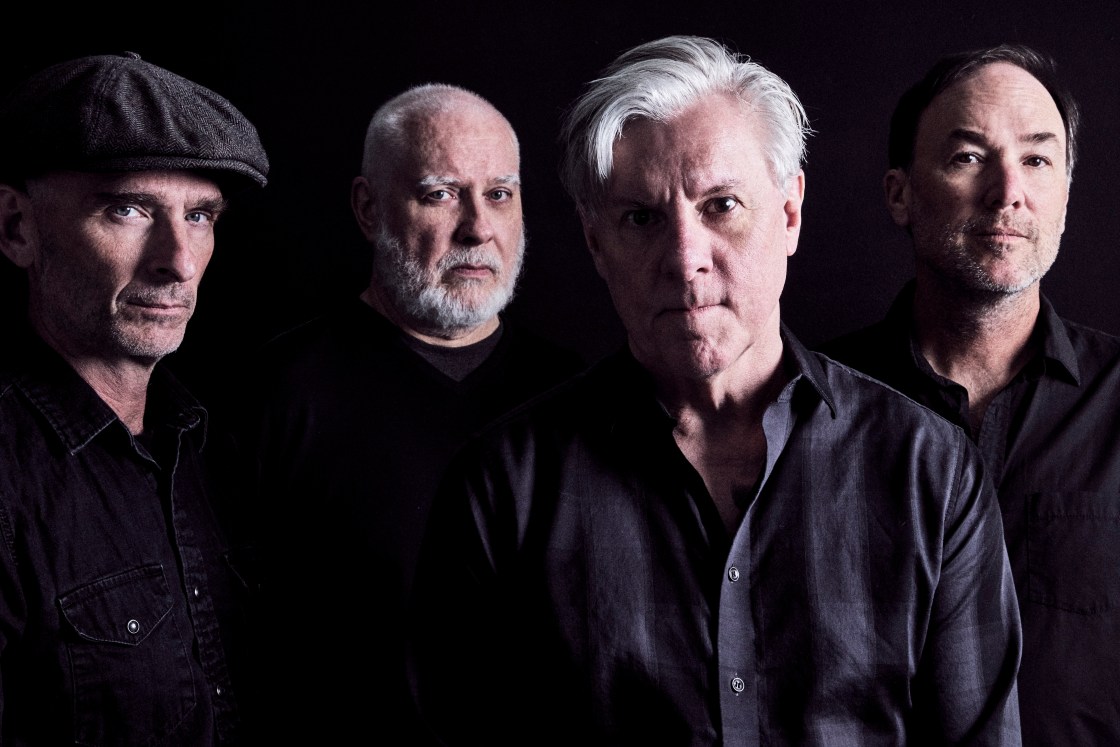
Vaden Todd Lewis and Clark Vogeler remember working on the band’s eighth album, one of Steve Albini’s final projects
This story discusses suicide and mental health. If you or someone you know is struggling or in crisis, help is available. Call or text 988 or chat at 988lifeline.org in the U.S. and Canada, or call 111 in the UK.
“I’ve done a lot of soul searching and thinking about my brain, and how it works.” Vaden Todd Lewis is in a different state of mind now. He didn’t land there after some sort of epiphany. He plodded through the chaos, the depression, uncertainty, and grief, fueled in recent years by the pandemic and personal loss, and longer term by the struggles with mental health he’s lived with for decades.
“I changed everything,” the Toadies frontman adds. “I wanted to take apart my thinking with depression and the weird, fucked-up thoughts I was having. I always just assumed that’s just part of being creative, and you have to suffer and all this shit.”
After starting therapy in 2022 and a light dose of medication, Lewis says he’s found a better balance. “It helps me stay even keel, rather than all the way in the dirt or flying around like a nut,” shares Lewis, who admits that he postponed getting help for years for fear of losing his ability to write.
“I was afraid I wouldn’t be able to write music if I cut that part of me off,” he adds. “But it turns out I can still be dark as hell if I want to.”
Dark is one appropriate word for some of the tracks Lewis wrote on the Toadies’ eighth album, The Charmer. A slippery slope of songs pressed by the psyche, confronting inner voices, and ultimately trying to heal. The Charmer also came full circle when the band connected with late producer Steve Albini. Recorded at Albini’s Electrical Audio studio in Chicago in 2023, The Charmer was one of the producer’s final projects before his death in May 2024.
Working with Albini was something the band had anticipated for decades. During the early ’90s, it nearly happened for the Toadies, but the collaboration with Albini—who had already helmed the Pixies’ Surfer Rosa, The Breeders’ Pod, Nirvana’s In Utero, and PJ Harvey’s Rid of Me, among dozens of other albums—never aligned.
“We had been talking about making an album with Steve Albini since 1996, when I joined the band, and Interscope was not into it for various reasons back in the day, and we couldn’t line it up,” says guitarist Clark Vogeler. “It’s just incredible to us that we managed to make a record with him before his untimely passing.”
Another throwback for the album is that it took a cue from the Toadies’ 1994 debut Rubberneck and was recorded completely analog. There were no computers, nothing digital on The Charmer, says Lewis, just a razor blade and tape.
“The whole spirit of the record was very much like when we did Rubberneck,” says Lewis. “I didn’t want it to sound like Rubberneck, but it really took me back to that headspace.”

The album is Toadies’ autobiographical, at their best, elbowing through mental health and even praising a cinematic anti-hero. The latter manifested at the start of The Charmer on “Ash’s Theme,” an instrumental ode to one of Lewis’ heroes, the boomstick-wielding Ash Williams from Sam Raimi’s 1987 comedy-horror Evil Dead II. A longtime fan of the Evil Dead franchise and actor Bruce Campbell, Lewis says he spent the COVID lockdown watching movies, and, of course, returned to one of his all-time favorites, along with its TV series, which ran from 2015 through 2018.
“I watched the movies again, and then the TV series, and I felt this adrenaline from it,” says Lewis. The grittier, horror-slanted imagery, and the band playing inside a boarded-up, derelict cabin in the woods in their 1994 video for the Rubberneck track “Tyler” was also loosely based on Evil Dead II.
“I had a riff in my mind, so I paused the ‘Evil Dead’ show, and went into my home studio and recorded it,” adds Lewis, who crafted a twisted Spaghetti Western-bent theme song, with surfy guitars and vocal chants. “I thought, ‘That is fucking weird. That’s so out there,’” says Lewis. “But it just seemed like an appropriate way to dedicate the song. I thought, ‘That motherfucker needs a theme song.’”
“Ash’s Theme” is a lighter note on The Charmer before the heavier narratives hit, such as those around emotional health, prompted by the pandemic, and the loss of Lewis’ father after being diagnosed with dementia.
“Come to Life” is the first of those, questioning his own paternal and filial roles—Am I a father / Am I a son / I feel like a ghost / I don’t feel like I’m the only one / Never a soldier / Never a saint / Never much to speak of—and more inner struggles on “Normal,” a song Lewis says was an attempt to write a pop song before it landed on something dimmer with him pleading, I just want to be fucking normal. “I thought, ‘I’m gonna sit down and write a 4/4 pop song,’” Lewis jokes. “I came up with the riff, and I recorded it, and then I realized it’s not in 4/4, and went down this fucking manhole of despair about not being able to do anything normal, so I wrote some words about it.”

Musically, the title track started while Lewis was trying to capture an “old-school Toadies” song, says Vogeler, but ended up burning deeper, lyrically. Always open about his mental struggles, which Lewis says he’s had throughout most of his life, “The Charmer” was inspired by realizing the two competing sides of his thoughts.
“There’s part of me, ‘The Charmer,’ that says, ‘You’re never going to be good enough,’ and then there’s the part of me saying, ‘I am good enough. Fuck you,’ and they battle,” shares Lewis. “So I decided to name that part of me The Charmer, because it tries to lure you back into self-doubt and undermining yourself. It’s very hypnotic. It’s an easy thing to get sucked back into.”
Perhaps the most penetrative track on the album, “Closer to You,” faces the fear of being diagnosed with dementia like his father, and Lewis’ preferred way out. Centered around suicide, Lewis calls “Closer to You” the “darkest, most grim song” he’s ever written, and admits that he’s still uncomfortable talking about it at times.
“With Rubberneck and Hell Below, and a lot of other records, I was into storytelling, and I would have characters and tell something about myself in their story,” Lewis says. “It was getting something off my chest, but in a way where I could just brush it off. With The Charmer, I really wanted to get in there and deal with some real shit.”
On tour, the band has also partnered with several mental health non-profits, including Amplified Minds and Punk Rock Saves Lives, which have had a presence at shows, and the band wants to connect with more around the U.S. during this tour.
“There’s the national suicide helpline,” says Lewis, “but having someone you can actually see and talk to is always good.”
The Charmer is dotted with quicker jolts like “Damage,” zipping in at just over two minutes on requited love. Then there’s “I Wanted to Be Everywhere,” a track Vogeler calls a “poppier” song with its major keys. Play
“The Toadies don’t have a lot of major key songs,” says Vogeler. “Major key songs have a happiness and a lightness to them. Most pop songs are major key, and they’re shiny and happy, but a lot of Toadies songs have a tension.” He adds, “[Vaden] doesn’t want anything to be just pretty. If the music is too pretty, he has to write really dark lyrics to offset that.” Another example of this, he says, is the
band’s 2008 No Deliverance track, “Song I Hate,” a bouncier Toadies story on breaking from a toxic relationship, which he co-wrote with Lewis and drummer Mark Reznicek. “I Walk a Line” is a track Vogeler says Albini “stretched” and enhanced for the band on The Charmer. “Even though he didn’t consider himself a producer, just a recording engineer, he had the ability to stretch out and pull back on his sound,” says Vogeler of Albini, “and he did so according to the song in front of him.”
Though a mostly “hands-off” producer, Albini did help the band land on specific guitar tones and piece other parts together. “Halfway through the record, he was like, ‘Let’s try this now. Let’s put this on that chorus,’” remembers Vogeler. “It was really cool to bring that out in him. I swear, he brought out in us more of a live band in the studio, and I feel in my heart that we brought out in him a little bit of his producer urges.”
The anthemic “Get Out of Your Head” is an “odd one,” Vogeler says, because it’s “Un-Toadies” with its stacked up harmonies and breakdowns. Before the more old-school Toadies-riffed “Gasoline Jane” comes the longest track on the album, “I Call Your Name.” This bluesier Texas grinder has meatier hooks and opens on Reznicek’s 30-second drum solo. Two minutes later, the guitars have their own moment, jamming for more than a minute with Lewis’ vocals coming in only at the end.
“I was trying to knock off a Nick Cave and the Bad Seeds vibe with the bass lines and the weird guitars and the drums, but whenever you try to knock something off, it always ends up as something else with your fingerprints all over it,” says Vogeler. “I’m fine that it doesn’t sound anything like Bad Seeds, because it became its own thing.”
For The Charmer, the band started sending “bits and pieces” of songs to each other as early as 2018, a year after releasing their seventh album, The Lower Side of Uptown. When lockdown hit during the pandemic, they continued the remote file sharing. Vogeler says The Charmer is possibly the most collaborative album the Toadies have made together, then jokes that he suffers from imposter syndrome when comparing his songs to Lewis’s. “I hear my songs in there, and I go, ‘They’re not as good as Vaden’s songs,” he says. “I’ve only shed imposter syndrome as a guitar player in the last few years, and it still creeps in.”

Writing with Lewis was a gradual process for Vogeler when he first joined the band in ’96 and started co-writing on the Toadies’ second album in 2001, Hell Below/Stars Above. “Early on, I didn’t want to get in his way, but over time, I saw that he was open to more collaboration,” says Vogeler. “That was a big hurdle for me, to see something I wrote become a Toadies song. I worried for a long time about diluting it or watering it down, and I didn’t want to be the guy that watered down the Toadies.”
Regardless of what band member contributes something, including Reznicek and bassist Doni Blair, once they get together, it always turns into a Toadies song. ”No matter what member of the band put something in front of him,” says Vogeler, “when [Lewis] starts singing, and we play it together, it sounds just like a Toadies song.”
By the end of The Charmer, Lewis leaves off with a fitting end, on healing. Also, the final track Lewis wrote for the album, “In Bandages,” delivers a somewhat “happier” ending, despite being prompted by a haircut gone wrong that Lewis had during the pandemic. “After the world opened back up, I sat down in the chair, and we’re talking, and he turns around, grabs his scissors, and stabs me in the face and sends me to the hospital, unintentionally,” remembers Lewis. The deeper meaning, he adds, “We’re getting back on our feet, but we’re still bandaged up.”
Now, the Toadies are definitely standing on more solid ground. The Charmer is a massive extension and elevation of the band’s catalog, one Lewis and Vogeler say is the band’s best work. They also praise Albini’s hand in it. “That is 99% because we were able to do this with Steve Albini, in his studio, and the sound that he brought to the record,” says Vogeler. “As a musician, you always wondered what your band would sound like with Steve Albini’s production on it. And now we know, and it sounds better than we would have imagined.”
Link to the story at spinmagazine.com

