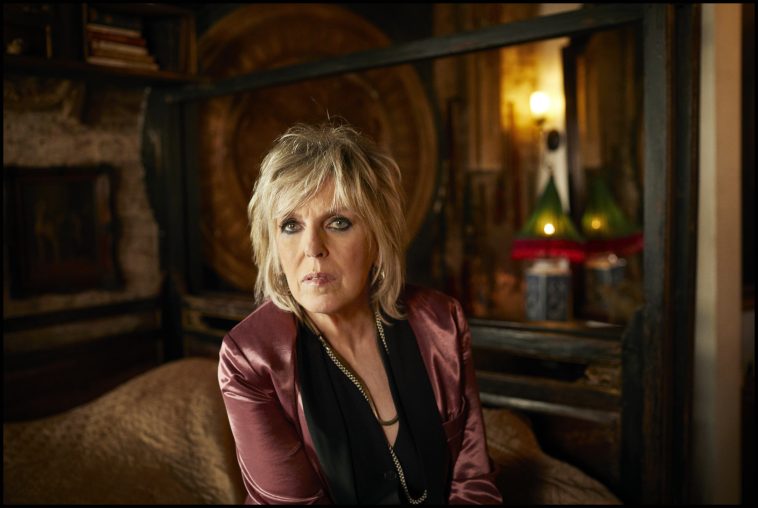
“The day John Lennon was shot, to me, that was the end of the innocence,” remembers Lucinda Williams, pausing to remember the day she learned one of her heroes died. “I remember feeling like everything had changed.” For Williams, growing up in Lake Charles, Louisiana, the Beatles were her “musical backdrop,” and the wallpaper (of posters) wrapping her bedroom walls.
“The Beatles, they represented that age of innocence,” adds Williams. “It was just everything—all the love and peace and flowers and ‘Strawberry Fields Forever.’”
It was “I Want to Hold Your Hand” and many of the Beatles’ earlier songs that she had grown up listening to on the radio, along with Meet the Beatles! her first introduction to the band left a lifelong imprint on the then-10-year-old Williams in 1963.
“They had such great melodies and arrangements,” adds Williams. “They were such an integral part of society, in the world, and our little world—our kid world.”
At 71, the singer and songwriter never imagined recording at the Beatles’ holy grail, Abbey Road Studios in London, but that’s exactly where she set up shop for three days to record an album of their covers. Lucinda Williams Sings The Beatles From Abbey Road is a collection of 12 Beatles songs performed by Williams and her band spanning the band’s A Hard Day’s Night through Let It Be with her interpretations of “Can’t Buy Me Love,” “Don’t Let Me Down,” “With a Little Help From My Friends,” and more.
“It doesn’t feel that old when you go in there,” says Williams of the studio. “It feels more contemporary, but it was good being in there, knowing how much music was made inside those walls.”
On the album, Williams also ventures into deeper cuts with the “Rain,” originally released as a B-side to “Paperback Writer”—both recorded during the Beatles’ Revolver sessions in 1966. “‘Rain,’ what a sweet little song,” says Williams reciting the opening If the rain comes, they run and hide their heads. “It’s about the weather. See, there’s that innocence again. He [Lennon] was looking at it from the perspective of a younger person belittling all these older British people who were complaining about the weather. Whether it was the sun or the rain, there was always a problem with the weather.”
[RELATED: Remember When: The Beatles Release ‘Sgt. Pepper’s Lonely Hearts Club Band’]
When tasked with picking her favorite Beatles songs for the album, Williams had the enormous task of whittling dozens down to 12. “I said, ‘You want me to pick my favorite Beatles song?’” Recalls Williams. “That’s impossible because there were so many good ones. I couldn’t imagine having to narrow down even 10 or 12 songs of their songs.”
Eventually, Williams sat with each, picking up on how the songs felt when she sang them. “Some were easier than others,” shares Williams. “I started digging into them realizing how much more complex a lot of them were than they appear to be. At first, I thought, ‘Oh, this is going to be a breeze, no big deal, no problem,’ but once you start trying to learn some of those songs, they’re really sophisticated arrangements, so it took a little bit of work to really get them to where we could play them and I could sing them.”
Prior to recording, Williams had never stepped foot inside Abbey Road but had met one Beatle, Ringo Starr, in the past. “The entire thing felt so precious, heavy, intense, and holy, so I had to get past that feeling of ‘Do not touch’ and just dive into it,” she says. “When I was younger, I would sing those songs to myself walking down the street or something. So I had to remember that that’s what it was all about.”
Among the deeper cuts, Williams took on “I’m Looking Through You” from Rubber Soul, a song Paul McCartney wrote about his then-girlfriend British actress Jane Asher, and Lennon’s jab at the British blues scene, “Yer Blues,” from Beatles’ 1968 self-titled release (The White Album).
Written during the band’s holistic retreat in Rishikesh, India, “Yer Blues” was a song that had a deeper connection to Williams decades after she first heard it. “You know how you hear songs, but you don’t really hear them?” says Williams. “I had heard it, but I hadn’t really focused on the lyrics of the song until I took it out. When I had the lyrics in front of me and listened to it again I went ‘Wow, this is really dark and deep.’”
She adds, “That [song] really took me for a ride. I just really grabbed onto it and loved singing. It might surprise some to know that it was a Beatles song.”
What struck Williams when she first heard “Yer Blues” was its link to Bob Dylan’s “Ballad of a Thin Man” in Lennon’s line I feel so suicidal, just like Dylan’s Mr. Jones. “I knew what he [Lennon] was talking about because I knew that Dylan song, and when that line came up, I went, ‘Oh my God, that’s crazy that he was obviously listening to that song, and he got it,’” says Williams.

“And they managed to fit it into that song, ‘Yer Blues,’ which tied into my whole Bob Dylan fanaticism,” she continues. “Once I got into my early teen years, it was all about Bob Dylan. It was basically the Beatles and Bob Dylan throughout my growing and learning musical years. They were the backdrop.”
Williams also connected to Lennon’s more somnolent missive to sleep, or lack thereof, “I’m So Tired,” also penned while suffering from insomnia during the band’s India jaunt. Capturing the more subdued temperament of the song was a challenge for Williams, who had to refrain from singing Lennon’s main line in a higher key. “I had trouble with that because of the way it starts out,” says Williams. “I had to restrain, pull back, and realize it’s not a big open note,” she adds as she sings I’m so tired in a dozier tone.
“When you listen to him sing, it sounds easy,” she says, “but there are these little, subtle changes that you don’t realize until you start to try to repeat what he’s doing.”
In 2020, Williams had already embraced the music of Dylan, Tom Petty, songs from Muscle Shoals, ’60 country hits, a holiday album, and her tribute to the Rolling Stones with her Lu’s Jukebox project recorded during the pandemic, without any concern. When it came to the Beatles, she felt more apprehensive about the entire project.
“I didn’t want people to compare,” shares Williams. “I was afraid of the reaction from everybody like ‘What is she thinking, trying to do Beatles songs?’ It’s such holy ground that I was treading over, especially Abbey Road, which is literally the Holy Grail.”
Remaining mostly faithful to the melody and arrangements of each song, Williams adds her own brooding pulse to each track with a rougher around the edges, electric guitar-pulled “While My Guitar Gently Weeps” and weightier “I’ve Got a Feeling,” one of the last songs the Beatles recorded during their rooftop concert atop their Apple Corps building in ’69.
“I wanted to stay true to their music and their songs, but still have it be me, and sound like me,” says Williams. “I never wanted to try to copy what they were doing, like a cover band doing Beatles songs.”
Even 60 decades later, Williams is still aware of the framework the Beatles gave her as a songwriter from her folkier 1979 debut Ramblin’ on My Mind, 1998 breakout Car Wheels on a Gravel Road, produced by Bruce Springsteen and the E Street Band’s keyboardist Roy Bittan, and through the present. Subconsciously cued to writing a great pop song, Williams says a turning point for her was when she wrote “Passionate Kisses.”
Initially released on her third album, Lucinda Williams in 1988, “Passionate Kisses” later became a hit for Mary Chapin Carpenter in 1992. Carpenter’s version, on her album, Come On Come On, went to No. 4 on the Country chart.
“Something shifted at some point when I wrote ‘Passionate Kisses,’” says Williams. “I felt like I created a really good pop song, and I didn’t set out to write a pop song, necessarily, but I’ve always loved great pop music. I’ve also loved rock music—the Doors and Jefferson Airplane and all that. Then there was all that great music, like Petula Clark singing ‘Downtown,’ and a lot of the Carole King stuff—just really good melodies that stick in your head.”
For Williams, refrains can often be the “meat and bones” of the song, and typically it’s always been melody first when writing, a system that has flipped for her over time. “I’ve been writing lyrics first, just concentrating on the words and then sitting with the lyrics,” she says. “Most of the time, something will pop in my head, a line with a melody at the same time. Those are the lucky moments, and when I get something like that, I have to find my phone and record it real quick. Once I have a melody, then I can sit and work on the lyrics as long as I have something to start with, even if it’s just a line. Then I can flesh out the rest of it, but it’s not always consistent. It’s never the same way each time.”
Taking a more archaic approach, Williams is also guilty of handwriting loads of papers of lyrics and parts of songs. She even wrote her 2023 memoir Don’t Tell Anybody the Secrets I Told You by hand. “Every so often I go through all the separate notes and put them in a file. At one point, it was getting so messy that I had to make files for different songs,” she says. “I’ll be working on one a little bit and another one the other day, or on different songs at one time, so I’ve made files for all the different songs and notes for each song.”
Some songs take Williams longer to complete than others, including “Drunken Angel,” which was released on Car Wheels on a Gravel Road, and written for her friend Austin country singer and songwriter Blaze Foley, after he was shot and died after an argument in a bar in 1989. Townes Van Zandt also penned a tribute to his friend, “Blaze’s Blues,” released in 1991.
“I remember that one [‘Drunken Angel’] was a long time coming,” recalls Williams, whose father, the poet Miller Williams, helped her with some of its lyrics. “When I was working on ‘Drunken Angel,’ it was pretty much finished, and I had this line, ‘blood flows out of a hole in his heart,’” Williams told American Songwriter in 2021. “He said, ‘I think it would be better if it was ‘the hole in his heart.’’ I never took a writing course, but I had him as a teacher.”
“Sometimes the song needs more work,” adds Williams. ‘They have to lie on their own for a while. It’s just trial and error.”
Personally, Williams has also lived through her own trials and tribulations. Just two days after recording The Rolling Stones for Lu’s Jukebox, Vol. 6, Williams suffered a stroke in November 2020, which she says she is still recovering from. Even after playing in the game for 45 years, and earning her three Grammy awards—for “Passionate Kisses,” Car Wheels on a Gravel Road, and her 2002 single “Get Right With God“—she remains mostly modest about her success.
When it comes to recognition, Williams is even more bashful. Even thinking of herself as a legend makes her somewhat embarrassed. “It’s kind of daunting to tell you the truth, even the word legacy,” says Williams. “I feel shy about.
It makes me feel self-conscious,” she adds. “But if people want to say that I’m a legend,” she adds with a soft giggle, “of course I’ll take it.”
Photos: Danny Clinch
The story appears in the January/February 2025 Issue of American Songwriter.
 Tina Eves